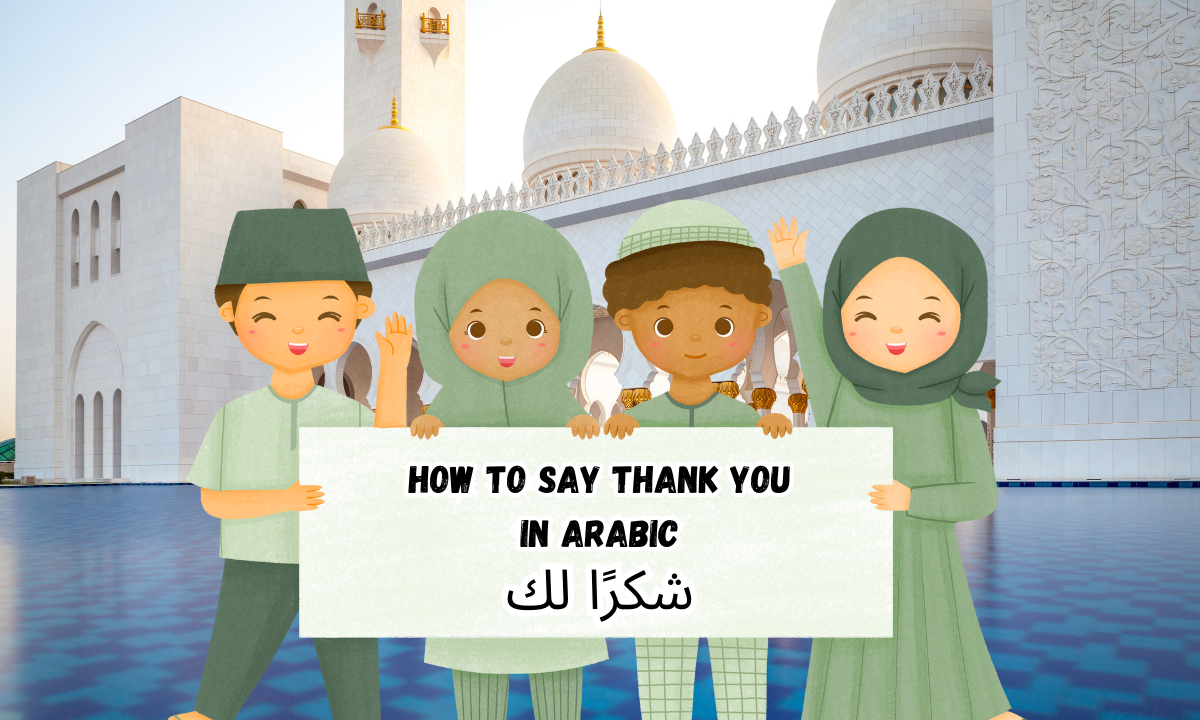
How do you say thank you in Arabic? The simplest answer is Shukran (شكراً) — it works in every Arabic-speaking country, formal or informal. But Arabic offers far more than one word: religious blessings, dialect-specific phrases, and heartfelt expressions each carry their own weight. Whether you’re travelling, working with Arabic speakers, or learning the language, this guide covers 15 ways to express gratitude — and how to respond when someone thanks you.
Thank you in Arabic — quick answer
“Thank you” in Arabic is Shukran (شكراً), pronounced shoo-KRAHN. For “thank you very much,” say Shukran Jazeelan (شكراً جزيلاً). The standard reply is Afwan (عفواً) — “you’re welcome.”
All 15 Phrases at a Glance
| # | Phrase | Meaning | Best For |
|---|---|---|---|
| 1 | Shukran (شكراً) | Thank you | Everywhere — the universal choice |
| 2 | Shukran laka / laki | Thank you (to a man / woman) | Directed, personal thanks |
| 3 | Shukran Jazeelan | Thank you very much | Stronger gratitude, slightly formal |
| 4 | Shukran ktir | Thanks a lot | Levantine dialect (Syria, Lebanon, Jordan) |
| 5 | Shukran awi | Thanks a lot | Egyptian dialect |
| 6 | Shukran bizzaf | Thanks a lot | Maghrebi dialect (Morocco, Algeria, Tunisia) |
| 7 | Teslam / Teslami | Bless you (to a man / woman) | Warm, casual Levantine thanks among friends |
| 8 | Mutashakker / Mutashakkerah | Thankful (male / female speaker) | Informal Egyptian |
| 9 | Saḥa (صحة) | “Health” — used as thanks | Maghreb, after meals or favors |
| 10 | Jazakallahu Khairan | May Allah reward you with goodness | Religious/Muslim contexts |
| 11 | Barakallahu Feeka / Feeki | May Allah bless you | Religious, warm and respectful |
| 12 | Laka Khaalis Ash-shukr | You have my sincere thanks | Formal, professional settings |
| 13 | Ashkuruka min A’maq Qalbi | I thank you from the bottom of my heart | Deep, genuine gratitude |
| 14 | Haza Lutfun Minnak | That’s kind of you | Graceful thanks for a favor |
| 15 | Ana Mumtanan Laka lilghayah | I am extremely grateful to you | When ordinary thanks isn’t enough |
Universal Phrases for Saying “Thank You”
Shukran (شكراً)
The most common way to say thank you in Arabic. “Shukran” is understood in every Arabic-speaking country and fits both formal and informal settings. Pronounce it shoo-KRAHN, with the stress on the second syllable — a common beginner mistake is stressing the first.
Shukran laka (شُكْرًا لَكَ)
To add a personal touch, say “Shukran laka” when thanking a man, or “Shukran laki” for a woman. It translates to “thank you to you” — a small change that makes your gratitude more direct.
Shukran Jazeelan (شُكْرًا جَزِيلاً)
For deeper gratitude, “Shukran Jazeelan” means “thank you very much” — pronounced shoo-krahn jah-zeel-an. The word “Jazeelan” adds intensity, signalling you’re genuinely appreciative.
Dialect Variations: How Locals Actually Say Thanks
Arabic dialects vary widely across 22 countries. Textbook phrases work everywhere, but these local variants will earn you smiles:
| Region | Phrase | Notes |
|---|---|---|
| Levant (Syria, Lebanon, Jordan, Palestine) | Shukran ktir; Teslam / Teslami | “Teslam” (bless you) is warm and casual, common among friends and family |
| Egypt | Shukran awi; Mutashakker / Mutashakkerah | Pronounced moo-ta-shak-kur / -ah; informal, among friends |
| Maghreb (Morocco, Algeria, Tunisia) | Shukran bizzaf; Saḥa (صحة) | “Saḥa” means health — used after meals or favors |
| Gulf | Close to Modern Standard Arabic | Softer “k” sound in Shukran |
Also Read: Wallah Habibi Meaning in Hindi — वल्लाह हबीबी का मतलब.
Religious Expressions of Thanks
Jazakallahu Khairan (جَزَاكَ اللهُ خَيْرًا)
Especially in Muslim communities, “Jazakallahu Khairan” — “May Allah reward you with goodness” — is considered one of the highest forms of gratitude. It doesn’t contain the word “thanks” at all; it invokes a blessing instead.
Barakallahu Feeka (بَارَكَ اللهُ فِيكَ)
“May Allah bless you” — said as “Barakallahu Feeka” to a man and “Barakallahu Feeki” to a woman. A warm, respectful phrase best suited to devout company; in secular settings, a simple Shukran may fit better.
Heartfelt and Formal Expressions
Laka Khaalis Ash-shukr (لَكَ خَالِصُ الشُّكْرِ)
“You have my sincere thanks.” The right choice for professional settings or when you want to show deep respect along with gratitude.
Ashkuruka min A’maq Qalbi (أَشْكُرُكَ مِنْ أَعْمَاقِ قَلْبِي)
“I thank you from the bottom of my heart” — for the moments when someone has made a real difference and you want them to know it.
Haza Lutfun Minnak (هَذَا لُطْفٌ مِنْكَ)
When someone does you a favor, “Haza Lutfun Minnak” — “this is kindness from you” or “that’s nice of you” — is a graceful, elegant way to acknowledge it.
Ana Mumtanan Laka lilghayah (أَنَا مُمْتَــنٌّ لَكَ للغَايَةِ)
“I am extremely grateful to you” — for when ordinary thanks just isn’t enough. A woman speaking says “Mumtana” instead of “Mumtanan.”
How to Respond When Someone Thanks You
Knowing how to say thank you in Arabic is half the exchange — here’s how to reply gracefully:
| Response | Meaning | Tone |
|---|---|---|
| Afwan (عَفْوًا) | You’re welcome (literally “pardon me”) | Universal, most common |
| Ash-shukru Lillah (الشُّكْرُ لله) | All thanks to God | Humble, religious |
| Ala Al-rahbi Was-sa’ah | My pleasure / you’re most welcome | Warm, welcoming |
| Haza Wajibi (هَذَا وَاجِبِي) | It’s my duty | Duty-bound, respectful |
| La shukran ‘ala waajib | No need to thank me for a duty | Formal |
| La Alaik (لا عَلَيْكَ) | Never mind / don’t mention it | Modest, casual |
| Innahu min dawa’e sorori | It is my pleasure | Polite, formal |
| Lais hunaka ay mushkila | There’s no problem | Reassuring, casual |
| Ahlan bika fi ay wakt | You’re welcome anytime | Friendly, open-ended |
Cultural Nuances and Common Mistakes
- Non-verbal gratitude: Placing your right hand over your heart with a slight bow is a widely understood gesture of sincere thanks.
- Don’t over-thank: Excessive thanking can feel awkward — a single sincere Shukran usually suffices.
- Mind the gender: Many phrases change with the listener — laka/laki, Feeka/Feeki, Teslam/Teslami. Using the wrong form is the most common learner mistake.
- Pronunciation: Stress the second syllable of Shukran (shoo-KRAHN), and practise the throaty “ḥ” in Saḥa.
Example Dialogues
Formal:
A: Shukran jazeelan! (Thank you very much!)
B: Afwan! (You’re welcome!)
Informal (Egyptian):
A: Mutashakkerah! (Thank you! — female speaker)
B: ‘Ala al-rahb wa al-sa’a! (Anytime!)
Also Read: Biped meaning: literal vs slang usage.
Also Read: Which Language Does the Word “Almirah” Belong To?
FAQs: Thank You in Arabic
Answer: Shukran (شكراً) means “thank you” in Arabic. It is understood in every Arabic-speaking country and works in both formal and informal situations. Pronounce it shoo-KRAHN, stressing the second syllable.
Answer: The most common reply is Afwan (عفواً), meaning “you’re welcome.” Other options include Ash-shukru Lillah (all thanks to God), La Alaik (don’t mention it), and Ahlan bika fi ay wakt (you’re welcome anytime).
Answer: Say Shukran Jazeelan (شكراً جزيلاً), pronounced shoo-krahn jah-zeel-an. In local dialects you can also say Shukran ktir (Levant), Shukran awi (Egypt), or Shukran bizzaf (Morocco, Algeria, Tunisia).
Answer: Jazakallahu Khairan (جزاك الله خيراً) means “May Allah reward you with goodness.” It is a religious way of expressing deep gratitude, common in Muslim communities, and is considered one of the highest forms of thanks.
Answer: Both. Shukran is neutral and fits every situation — with friends, strangers, elders, or in professional settings. For extra formality, use Shukran Jazeelan or Laka Khaalis Ash-shukr (you have my sincere thanks).
Conclusion
Learning how to say thank you in Arabic is about more than memorizing phrases — it’s about matching the right expression to the moment. Start with Shukran, add the dialect variant of wherever you’re headed, and keep Jazakallahu Khairan for when a blessing says more than thanks ever could. With 15 phrases and 9 replies in your pocket, you’re ready for almost any exchange.
We thank you from the bottom of our hearts for reading. نشكُرُكُمْ مِنْ أَعْماقِ قُلُوبِنا — Nashkurukum min A’maki Kolubina!
