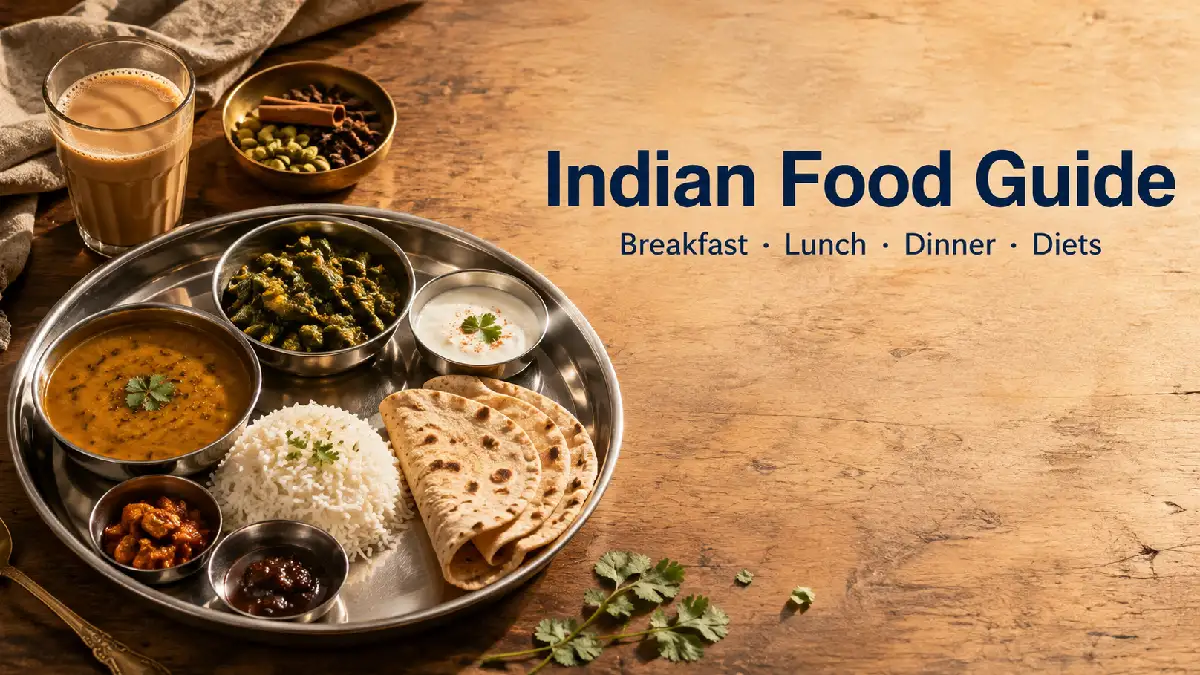
Indian food is easiest to understand one meal at a time. Breakfast changes completely every few hundred kilometres, lunch is usually the largest and most structured meal of the day, and dinner is where most households now cut back. This guide is organised the same way — by meal first, then by diet goal, then by the ingredients and brands that sit behind all of it — with a detailed guide linked at every step.
Indian breakfast, by the kind of morning you have
Breakfast is the meal with the widest regional spread in India, and it is also where most people are looking for a decision rather than a recipe: what can I actually make in the time I have? The honest answer depends on your morning, so the guides below are split by constraint rather than by dish.
- When you have five minutes — poha, chilla and upma variants that genuinely finish inside the time. 5-minute Indian breakfasts
- When you want the North Indian classics — parathas, bedmi, poori-sabzi and the rest of the belt. Top 11 North Indian breakfast recipes
- When you want to plan the whole week — a seven-day rotation so no morning starts with a blank mind. 7-day healthy Indian breakfast plan
- When you are eating vegan and tracking protein — the dozen Indian breakfast foods that clear both bars at once. Vegan, high-protein Indian breakfasts
- When you are managing PCOS — low-glycaemic, protein-forward mornings that do not spike insulin. PCOS-friendly Indian breakfast ideas
- When you simply want it to be healthier — the nutrition-first version of the everyday Indian breakfast. Healthy Indian breakfast recipes
- When you want the regional map — what breakfast actually looks like from Assam to Tamil Nadu. Traditional Indian breakfasts across regions
Lunch and dinner
Lunch in most Indian homes is still the anchor meal — dal, a sabzi, roti or rice, something fermented or pickled on the side. Dinner is where the modern compromise happens: it has to be quick, and increasingly it has to be lighter. Both problems have their own answer.
- Quick Indian dinner recipes for busy nights — for the evenings when cooking is not optional but time is short.
- 10-minute vegetarian Indian recipes — the shortest realistic route to a full vegetarian plate.
- Low-calorie Indian dinners — lighter evening meals that still taste like dinner, not like a compromise.
- Indian diet and dinner recipes for weight loss — the same idea extended into a full plan.
- Indian lunch box ideas for school — food that has to survive four hours in a steel dabba and still get eaten.
Dishes and regional plates worth knowing
Some dishes are worth learning on their own, either because they explain a whole region or because they turn up on every menu. The Indian thali is the clearest single illustration of how an Indian meal is balanced — every element on the plate is there for a reason, not for decoration.
- How to make dhokla — the fermented Gujarati snack that works equally well as breakfast.
- Tikka masala and the Indian fusion menu — how the best-known “Indian” dish abroad actually came to be.
- Types of Indian sweets — mithai grouped by what it is made from, which is the only way it makes sense.
- Kodo millet recipes — one of the millets that has moved from forgotten grain to everyday staple.
Eating for a specific goal
Most people arrive at Indian food with a target rather than a craving — more protein, a safe pregnancy diet, fewer calories. Vegetarian Indian diets in particular get accused of being protein-poor, which is only true if you build the plate badly. The high-protein Indian food chart lays out how much protein everyday Indian foods actually carry, so the plate can be corrected with what is already in the kitchen.
For pregnancy, the priority shifts to iron, folate and digestibility rather than sheer quantity — the South Indian recipes for pregnancy guide covers dishes that are gentle and nutrient-dense at the same time. For weight loss and PCOS, the two guides linked above under dinner and breakfast are the more useful starting points.
The ingredients and brands behind the food
Recipes assume the ingredient is good. Often that is the part worth checking first — adulterated ghee, mass-market chicken sold as country chicken, or tea blended down to dust will undo any amount of technique.
- How to identify desi chicken — body shape, comb, feather colour and behaviour, so you are not sold broiler at country-chicken prices.
- Desi cow ghee brands — which brands are actually A2 desi cow ghee and how to read the label.
- Top tea companies in India — the manufacturers behind almost every packet on the shelf.
- The ten Assam estates — for when the packet is not enough and the garden matters.
- Chocolate brands in India — from everyday bars to the single-origin makers now working with Indian cacao.
- Indian ice cream flavours — kesar pista, sitaphal, mishti doi and the rest, with their Hindi names.
Where to start
If you are cooking Indian food regularly for the first time, this order gets you furthest with the least effort:
- Fix breakfast first — it repeats every single day, so improving it compounds faster than anything else.
- Build a rotation of four or five dinners you can cook without thinking, then widen it slowly.
- Learn one thali properly. It teaches balance better than any individual recipe.
- Only then worry about diet targets — protein, calories, specific conditions.
- Upgrade the staples — ghee, tea, and the meat or dal you use most. This is usually the biggest single jump in quality.
Common questions
What is a typical Indian breakfast?
There is no single typical Indian breakfast — it is regional. The North leans on parathas, poha and chilla; the South on idli, dosa and upma; the East on luchi and pitha; the West on thepla and poha. What they share is that breakfast is cooked fresh rather than assembled cold.
Is Indian vegetarian food high in protein?
It can be, but not by accident. Dal, rajma, chana, paneer, curd, soya and peanuts all carry real protein; a plate of only rice and one sabzi does not. Building to a target means choosing deliberately rather than assuming the cuisine handles it.
Which Indian meal should be the heaviest?
Traditionally lunch, and the logic still holds — it lands when digestion and activity are both at their peak. Shifting the largest meal to late dinner is the change most often linked to weight gain and poor sleep.
How do I tell real desi cow ghee from ordinary ghee?
Check whether the label names the breed and says A2, whether it states bilona or hand-churned, and what it costs — genuine desi cow ghee cannot be produced at commodity prices. The ghee guide above goes through the specific brands and their labels.

12 thoughts on “Indian Food Guide: Breakfast, Dinner, Diets and Brands”
Comments are closed.